
Understanding the Ausbildung Age Limit in 2026 is the single most critical step for Pakistani candidates planning their vocational pathway to Germany. There is no legal upper limit, yet almost every agency page quotes employer preferences as if they were rigid legislation. The German Federal Employment Agency’s official guidance on vocational training sets out the baseline framework for international trainees without imposing any strict age threshold. It merely observes that most trainees enter right out of secondary school, a statistical trend, not an exclusionary policy.
That distinction matters enormously if you are 29 and have been told you are too old. When assessing the Ausbildung Age Limit in 2026, you are not legally barred; you are simply competing on merit and profile strength.
What the Law Says vs. Adverts on Ausbildung Age Limit in 2026
Search for the Ausbildung Age Limit in 2026 online and you will see arbitrary boundaries: 18 to 30, 17 to 35, or 16 to 20. None of these figures represent statutory law. Instead, they stem from three separate sources: individual enterprise hiring criteria, specific corporate recruitment drives, and consultancies filtering candidates early to trim applicant queues.
Our structured Ausbildung programme lists eligibility starting from age 17 without an artificial ceiling, presenting the authentic regulatory landscape for applicants.
Minimum Age Realities and the Practical Ausbildung Age Limit in 2026
While there is no maximum cut-off, the lower boundary of the Ausbildung Age Limit in 2026 is anchored by German youth labour legislation (Jugendarbeitsschutzgesetz) and graduation milestones. In practice, this puts the operational entry floor at 17 or 18 years old. Candidates under 18 trigger strict rest-period and night-shift compliance rules that many companies prefer not to manage for overseas recruits.
If you are 16, focus your time on language preparation rather than premature applications. Entering the cycle with verified credentials already secured puts you far ahead of the competition.
Why Older Candidates Face Hurdles Under the Ausbildung Age Limit in 2026
Evaluating the Ausbildung Age Limit in 2026 requires separating formal eligibility from employer competitiveness. Because companies fund three years of instruction while paying a training wage, many naturally favor younger candidates who represent long-term retention.
However, this disadvantage narrows substantially across high-demand vocational fields. In healthcare, geriatric nursing, hospitality, and specific industrial trades, severe labour deficits make mature, dependable candidates highly desirable. An applicant in their early 30s with documented technical exposure and solid language credentials routinely outperforms an unproven 19-year-old.
How to Win If You Exceed the Typical Ausbildung Age Limit in 2026
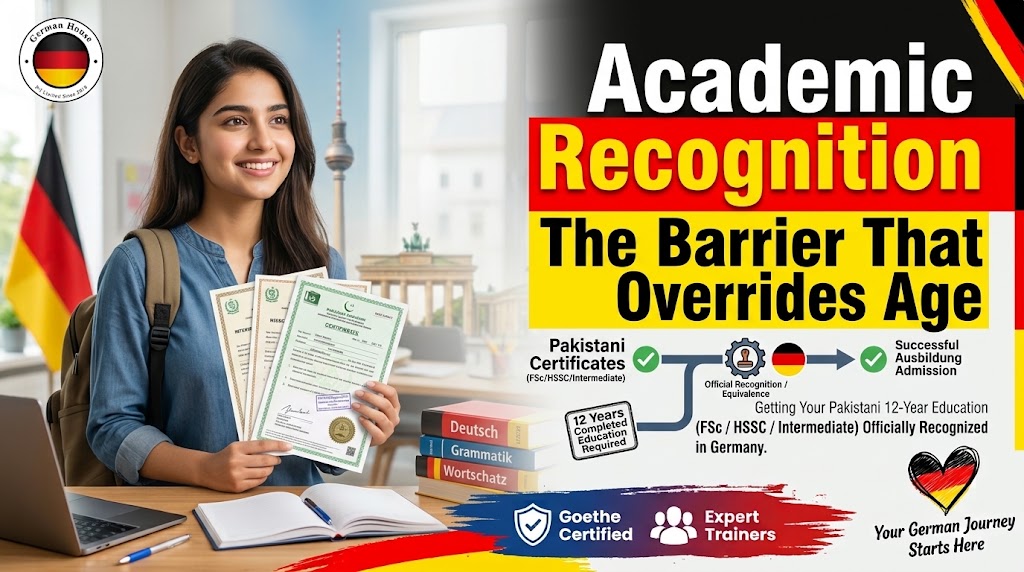
Academic Recognition: The Barrier That Overrides Age
Academic documentation causes far more rejections than any assumed Ausbildung Age Limit in 2026. German vocational institutes require roughly 12 years of completed education such as an Intermediate, HSSC, or FSc certificate and that qualification must be officially recognised.
If you are navigating the Ausbildung Age Limit in 2026 at age 30 or above, adjust your application framework across three areas:
- Documented Workplace History: Shift multi-year clinical, culinary, or technical experience to the very top of your profile rather than treating it as an afterthought.
- Superior Language Fluency: While B1 is the nominal threshold, achieving B2 resolves concerns regarding adaptability and puts an older candidate at the top of the shortlist.
- Target Shortage Occupations: Focus on critical-need vocations where companies lack domestic applicants, rather than oversubscribed administrative roles that can afford arbitrary age filtering.
Matriculation alone rarely satisfies the standard for qualified dual training. Prioritize your document attestation and equivalence checks early through official portals like anabin, as processing queues cannot be accelerated at the final hour.
Language Proficiency: The Deciding Variable
Whatever your bracket regarding the Ausbildung Age Limit in 2026, German language ability remains the ultimate gatekeeper. No candidate secures a visa at 19 without language proficiency, and no candidate is rejected at 35 on age alone if they hold verified B2 certification.
Certification is the one factor entirely within your control. Review our detailed guide on the German language test in Pakistan for examination routes, and consult our breakdown of German language levels A1 to C1 to identify course milestones.
Financial Clearances and Family Logistics
A crucial element often ignored during debates on the Ausbildung Age Limit in 2026 is personal finance. As a non-EU applicant, your training stipend must satisfy standard German subsistence guidelines; if it falls short, a supplementary blocked bank account is mandatory. For mature candidates relocating with dependants, these financial thresholds increase significantly. Calculate your complete balance sheet before signing your training contract.
The Definitive Assessment for Applicants
- Ages 17 to 29: You fall within the standard applicant profile with standard intermediate schooling and a B1 certificate.
- Ages 30 to 39: The Ausbildung Age Limit in 2026 permits full eligibility, provided you counter age bias with practical trade experience and B2 language proficiency.
- Ages 40 and Above: Legally valid, though securing an apprentice visa becomes significantly more complex. Skilled immigration or the Opportunity Card (Chancenkarte) often provides a faster route.
Your birth year is secondary to your language level. Start learning German early to build a competitive application.
Frequently Asked Questions
1. Is there an official Ausbildung Age Limit in 2026 for international applicants?
No. German statutory law enforces no maximum ceiling for training contracts. Advertised cut-offs reflect private company preferences.
2. Can Pakistani candidates qualify past the typical Ausbildung Age Limit in 2026 at age 30?
Yes. Applicants at 30 remain eligible and competitive, especially when applying to designated shortage trades with verified experience.
3. Does the Ausbildung Age Limit in 2026 disqualify applicants aged 35 or 40?
No legal bar exists, but placement criteria tighten. Mature applicants should weigh training against direct skilled employment pathways.
4. What is the practical minimum Ausbildung Age Limit in 2026?
Practically 17 or 18 years of age, matching school graduation and German statutory adolescent labour regulations.
5. Does matriculation satisfy vocational criteria regardless of age?
No. Dual vocational training expects 12 years of formal education comparable to the German school-leaving standard.
6. Do educational certificates require attestation for vocational training?
Yes. All Pakistani academic papers must be formally attested and evaluated for German equivalence prior to visa issuance.
7. Does the embassy reject visa files based on the Ausbildung Age Limit in 2026?
Visa officers assess training contracts, verifiable documentation, living cost coverage, and certified language scores rather than age alone.
8. Which industries are most receptive to mature candidates?
Healthcare, geriatric care, logistics, gastronomy, and industrial maintenance actively welcome mature career switchers.
9. Is B1 proficiency sufficient if an applicant is older?
B1 meets baseline regulatory criteria, but achieving B2 neutralizes employer concerns regarding workplace integration.
10. Should candidates over 35 pick vocational training or direct employment routes?
Applicants with completed degrees and substantial experience often transition faster through skilled worker or Opportunity Card visas.
The discussion around the Ausbildung Age Limit in 2026 is obscured by widespread misinformation. Because federal regulations set no legal barrier, your success depends on targeted sector selection, correct document equivalence, and advanced language acquisition.
German House provides comprehensive A1 to C1 training programs both online and on-campus led by Goethe-certified instructors. Explore our complete German courses catalog or message our team via WhatsApp at 0327 4966665 to begin your profile evaluation.